
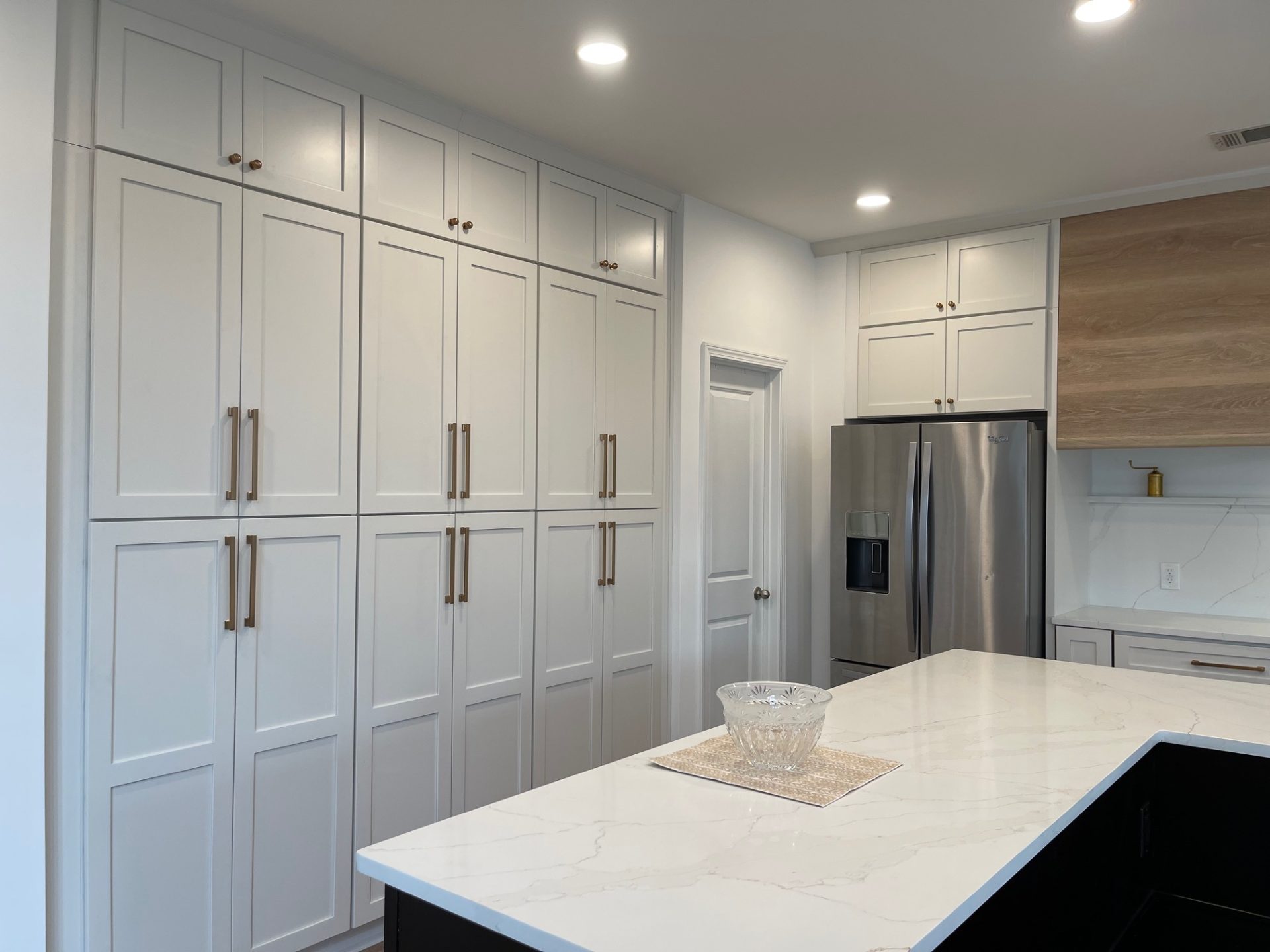
Should You Replace or Refinish Your Kitchen Cabinets?
Your kitchen feels dated. The cabinet doors have seen better days, the finish no longer fits the rest of your home, and you’ve started saving photos of kitchens that look nothing like the one you currently have.
The obvious solution might seem to be replacing the cabinets entirely.
But then another possibility comes up: why not simply refinish what you already have?
For some kitchens, refinishing existing cabinetry can be a practical way to refresh the space without starting over. In others, it amounts to investing time and money into cabinets that still won’t solve the problems that made you consider remodeling in the first place.
The right answer depends less on how your cabinets look today and more on what is underneath the surface.
If you’re already considering new cabinetry, our Ultimate Homeowner’s Guide to Buying Kitchen Cabinets covers the materials, construction, planning, layout, and budgeting decisions worth understanding before you make that investment.
First, What Does Refinishing Actually Change?
Refinishing is primarily a cosmetic solution.
Depending on the existing cabinets, the process may involve stripping or sanding the current finish, making minor repairs, and applying new paint or stain. Refacing goes a step further by replacing doors and drawer fronts and covering visible cabinet surfaces while leaving the existing cabinet boxes in place.
Both approaches can significantly change how a kitchen looks.
What they don’t fundamentally change is the cabinetry underneath.
The existing cabinet boxes remain. The drawer construction remains. The layout remains largely the same. And unless hardware is separately replaced or upgraded, much of the everyday functionality remains unchanged too.
That’s an important distinction when deciding whether refreshing or replacing makes more sense.
When Refinishing Can Be a Smart Choice
If your existing cabinets are well built, in good condition, and arranged in a layout that already works for you, replacing them simply because you dislike the finish may be unnecessary.
Imagine a kitchen with solid cabinetry, sufficient storage, and a layout that functions perfectly well. The only problem is a dark wood finish that makes the room feel heavier than you’d like.
In that situation, a cosmetic update could create much of the visual transformation you’re looking for without replacing perfectly functional cabinetry.
The condition of the cabinets matters, though. Doors should operate properly, cabinet boxes should remain structurally sound, and there shouldn’t be significant moisture damage, warping, or deterioration hiding beneath the finish.
Refinishing works best when the cabinets themselves aren’t the problem.
A New Finish Can’t Fix a Bad Layout
This is where the decision becomes more interesting.
Perhaps your cabinets are technically still usable, but you dislike where everything is located. The preparation area is too small. Storage is concentrated in the wrong places. A corner is difficult to access. The refrigerator interrupts the natural workflow. Or there simply aren’t enough cabinets for the way your household uses the kitchen today.
Painting the doors won’t solve any of those problems.
If you’re already investing in countertops, appliances, flooring, or other major parts of the kitchen, preserving a frustrating cabinet layout simply to avoid replacing the cabinets can limit what the remodel ultimately accomplishes.
Our guide to Choosing the Right Kitchen Cabinet Layout explores this in more detail, including how storage, work areas, appliances, and traffic flow can be considered together.
Sometimes the biggest improvement isn’t changing what the cabinets look like. It’s changing where they are.
Look Closely at the Cabinet Construction
Before deciding to preserve existing cabinetry, take some time to understand how it’s built.
Cabinets experience years of repetitive use. Drawers carry heavy cookware. Hinges support doors through thousands of opening and closing cycles. Areas near sinks and dishwashers are repeatedly exposed to moisture.
Signs of deterioration aren’t always dramatic.
Drawer boxes may begin separating at the joints. Shelving may sag. Doors may no longer align correctly. Cabinet boxes can swell or become damaged around plumbing. Hardware may have loosened repeatedly because the material no longer holds it securely.
If you’re already seeing structural problems, refinishing may improve the appearance while leaving the underlying weaknesses untouched.
If you’re unsure what separates durable cabinetry from lower-quality construction, our What Makes a High-Quality Kitchen Cabinet? guide explains the materials, joinery, hardware, and construction details worth examining.
Consider What Else Is Changing in the Kitchen
A cabinet decision shouldn’t be made in isolation.
Think about the complete remodel you’re planning.
Are you replacing the countertops? Changing appliances? Moving the sink? Opening the kitchen into another room? Adding an island? Replacing flooring?
The more substantial the renovation becomes, the more important it is to ask whether preserving the existing cabinets is actually helping or restricting the project.
New countertops, for example, are typically fabricated specifically for the cabinets beneath them. If you spend significantly on new surfaces now and decide several years later that the cabinets need replacing after all, you may create additional complications and expense.
A cosmetic refresh makes the most sense when the rest of the kitchen is receiving a relatively cosmetic refresh too.
Think About How Long You Want the Solution to Last
Budget understandably plays a major role in the decision.
Refinishing can involve a lower upfront investment than replacing an entire kitchen’s cabinetry, particularly when the existing cabinets are in excellent condition.
But upfront cost shouldn’t be the only comparison.
Ask yourself what you’re expecting from the project.
If you want the kitchen to feel fresher for a few more years, working with what you already have may accomplish exactly that. If you’re undertaking a major remodel because you want the kitchen to function differently for the next decade or longer, investing in new cabinetry may make more sense.
The age of your existing cabinets doesn’t automatically determine the answer either. Construction quality and condition matter far more than the number on the calendar.
Our article How Long Should Kitchen Cabinets Last? takes a closer look at the factors that determine cabinet longevity and the signs of construction designed for long-term use.
Replacement Opens Up More Possibilities
Starting with new cabinets gives you something refinishing can’t: the ability to rethink the kitchen itself.
You can reconsider where drawers would be more useful than doors, improve pantry storage, change the balance between base and wall cabinetry, or create a layout that better suits the way you cook and entertain.
It also gives you the opportunity to choose construction and hardware based on what you want from the next kitchen rather than simply accepting what’s already there.
That doesn’t mean every kitchen needs custom cabinetry.
Standard cabinet sizes can be combined into highly functional layouts for many homes, particularly when the design is planned carefully. If you’d like to understand how that works, our Standard Kitchen Cabinet Sizes Explained guide covers the basic dimensions and how they come together in a kitchen design.
When New Cabinets Make More Sense
Replacing the cabinets becomes particularly worth considering when several issues are happening at once.
Maybe the finish is dated, but the drawers are also worn. Storage isn’t working. The layout frustrates you. The cabinet boxes have seen better days, and you’re already planning to replace countertops and appliances.
At that point, refinishing may address the most visible problem while leaving most of the reasons you wanted a new kitchen untouched.
New cabinetry gives you the opportunity to address appearance, construction, storage, and layout as one coordinated project.
At Jessen Cabinets, our White Shaker RTA cabinets are built from real wood and include dovetail drawer boxes and soft-close hinges and drawer slides. Because we focus on one timeless style and keep common cabinet sizes in stock, homeowners can access quality new cabinetry without automatically moving into the cost and lead times associated with fully custom cabinets.
Our in-house design team can also help turn your kitchen measurements into a new layout, so you can compare what you have today with what your space could become.
Don’t Remodel the Same Kitchen Twice
There is nothing wrong with keeping existing cabinets when they’re genuinely worth keeping.
In fact, if they’re structurally sound, function well, provide enough storage, and fit your plans for the space, refinishing them may be exactly the right approach.
The mistake is assuming that because cabinets can be refinished, they necessarily should be.
Before deciding, look beyond the doors. Consider the condition of the cabinet boxes, the quality of the construction, the usefulness of the storage, and whether the existing layout supports the kitchen you actually want.
A remodel should solve the problems that matter to you, not simply make those problems look newer.
If replacing your cabinetry is beginning to make more sense, our Ultimate Homeowner’s Guide to Buying Kitchen Cabinets can help you understand the next steps, from evaluating cabinet quality and materials to planning your layout and choosing the right option for your budget.
Ready to Explore What a New Kitchen Could Look Like?
If you’re unsure whether your existing cabinetry is still the right foundation for your kitchen, start by exploring what’s possible with a new layout.
Jessen Cabinets offers complimentary in-house kitchen design support to help homeowners turn their measurements and ideas into a functional kitchen plan.
Our White Shaker RTA cabinets feature real wood construction, dovetail drawer boxes, soft-close hardware, and in-stock availability for fast nationwide shipping.
Visit kitchen.jessencabinets.com to request a free quote and start planning, or call 404-856-5461 to speak directly with our team.